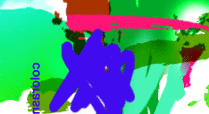










colorasm is an art project by vagRearg
"You cannot sell the inspiration,
but manuscripts - they are for sale"
A.S. Pushkin

Formally, the colorasm as a conceptual project addresses several issues evolved recently (and not so recently) in relation to digital and net-art, significance of commerce and the value, ownership and authorship, rights and the basis for such in the realm of open cultural texts.
Informally, for the project's authors, colorasm is a peculiar net-experiment, an open-ended game of art and commerce conceived at the moment of declarative appropriation of 16,777,216 digital colours.
Recontextualising colour by treating it as a digital commodity we maintain that nothing substantially new needs to be introduced in order to adapt to consumption of virtual goods. We attempt to prove this point by applying (1) common sense and (2) superficial analysis of traditions of art and commerce.
1. Exact reproduction
"The rate of semiotic slippage can potentially
accelerate and blur yet further the traditional distinction between [...]
text and image."
Robert S. Nelson
From the start, a major factor presented as an obstruction to commodification of digital art, was its characteristic of exact reproduction. Indeed, as has been repeatedly empirically proved, an exact reproduction of a digital artwork could be easily made and the copy would be identical to the original. The absence or over-presence of authentic original, when it comes to digital and net-based art, became commonplace. Essentially, each copy is as authentic as the copied.
However, a closer look indicates that this phenomenon is scarcely paradoxical. Тhe alleged problem originates with associating or relating digital art to the domain of visual and plastic arts. The mere fact of our "gazing" at a computer monitor, while perceiving digital art is not a sufficient condition to classify digital art as a sub-species of visual arts. Once we refuse this classification, zoom-out a bit and include within our viewport other art forms, such as music or literature, we see that the absence of the original does not present an obstacle. A hand-written score by Mozart possess value of course - but a purely historical one. It would not be considered an object of art. An original manuscript by Goethe, as far as literature concerned, may not exist. The artistic value of the Requiem and that of Faust appears in their (fully reproducible) content, or, precisely, in their code.
2. Open art content, commerce and ownership
Comparing objects of net art to traditional commodities in the cultural and social context, the first question to ask is how can anything readily available to everybody be bought? How can ownership be established and manifested in a situation when the merchandise is a mere sequence of 1s and 0s openly put on the net and duplicated into cache by every browser?
We note in parentheses that net-based artworks have been sold for quite a few years already, and have been acquired by museums and private collectors, yet, proposed systems of acquisition, such as URL dependent authenticity, are somewhat unnatural and always subordinate.
Clearly, the copyright distribution method, natural for
literature and music would not work. Neither would the square
approach to possession of tangible goods, such as paintings, be of
use.
But one more zoom-out and we see that the fact of having a unique,
tangible entity or even a duplicate copyright is necessary, but
not a sufficient condition in the definition of a commodity. In
many "linear world" cases no tangible goods change hands and the
acquisition is in fact solely a mere declaration of such. One
example could be the issuing of licenses, another is the stock
exchange market - both undeniably established areas of commerce,
where the item offered for sale is simply a right or right to
claim a right. Piece of paper may be issued (certificate,
voucher), but not the paper as material is bought. It just stands
a signifier for a certain idea, certain code.
3. Appropriation
Various appropriations in the art sphere, presented as borrowings or
sometimes citations, originated in ancient times and developed
substantially since then, supported by the semiotics theory of
dynamics for meaning of recontextualised or "borrowed" signs.
For web-based objects, recontextualisation is even easier and more
tempting, as 0100101110101101.org stated in 1999:
"Cloning is just one of the things you can do with these [net-based art] works. You can modify them, you can add things, you can put them in a different order, you can even destroy them, you can do anything you want."
In the non-artistic sphere appropriation is also a common practice, yet of a different nature. Some appropriations are legal, as in the case of open source and public domain content, some other are semi-legal, such as selling moon-land or domain names - acts claiming ownership of previously unclaimed entities.
4. colorasm project notion
By selling a digital code of colour, colorasm appropriates the concept of colour that until now has remained unclaimed, a concept that can be considered to be a public domain entity. By sticking on colour the label of commodity - colorasm establishes a new contextual meaning for the colour sign. The code of a colour is delivered to a buyer prior to the act of purchase, and remains available to any party upon this act. By setting a price and selling the colour, a priori less valuable than a work of art, colorasm is attempting to verify the theory of open web art/content marketing. The idea becomes further maintained through the issuing of a certificate of ownership for each colour and creating a system for reselling it.
References and suggested links
A. S. Pushkin 1824
Conversation Of a
Bookseller With a Poet.
Translated by V. Shapiro.
Robert S. Nelson 2003
Appropriation: Critical Terms for Art History.
Chicago: University of Chicago press.
<nettime> 1999
Interview with 0100101110101101.ORG
http://www.nettime.org/Lists-Archives/nettime-l-9912/msg00064.html
Sven Spieker's interview with Olia Lialina 1999
Dispelling the Myth that Net
Art is (not) a Commodity
Olia Lialina. ARTMARGINS
http://www.artmargins.com/content/eview/third.html
0100101110101101.org
http://www.0100101110101101.org/
art.teleportacia
http://art.teleportacia.org/
colorasm project is initiated and developed by vagRearg, Vadim Penzin and Leo Rothman. Special thanks to Jonathan Lubelle.